
Los verbos en -ar
The accent marks the past: hablo is now, habló is done
| Infinitive | Yo | Él / ella |
|---|---|---|
| hablar | hablé | habló |
| llamar | llamé | llamó |
| cenar | cené | cenó |
| comprar | compré | compró |
| trabajar | trabajé | trabajó |
Hablé, Habló
Pressing play loads the video from YouTube, which may set its own cookies. Privacy
Quick check · one tap
Yo (I) or él (he)? Read what the line means, then choose the form that fits.
Ayer y cené con Ana.
Yesterday I worked, then dined with Ana.
Or listen and type: hear a line, write the missing words.
Free · by email · 7 days
One short email a day for a week: one piece of Spanish, the lines Sol sings it in, a minute of practice.
Learn the Spanish past tense (the pretérito) of regular verbs in one song. -ar verbs end in -é and -ó, -er and -ir verbs in -í and -ió, and the accent is what makes it past: hablo is now, habló is done.
Also on YouTube.
Practice
Yo (I) or él (he)? Read what the line means, then choose the form that fits.
1.Ayer y cené con Ana.
Yesterday I worked, then dined with Ana.
2.Ayer trabajé y con Ana.
Yesterday I worked, then dined with Ana.
3.Anoche en casa de Luis.
Last night I ate at Luis's place.
4 more questions after these.
0 of 7 answered
Free · by email · 7 days
One short email a day for a week: one piece of Spanish, the lines Sol sings it in with what they mean, and a minute of practice.
Free printable
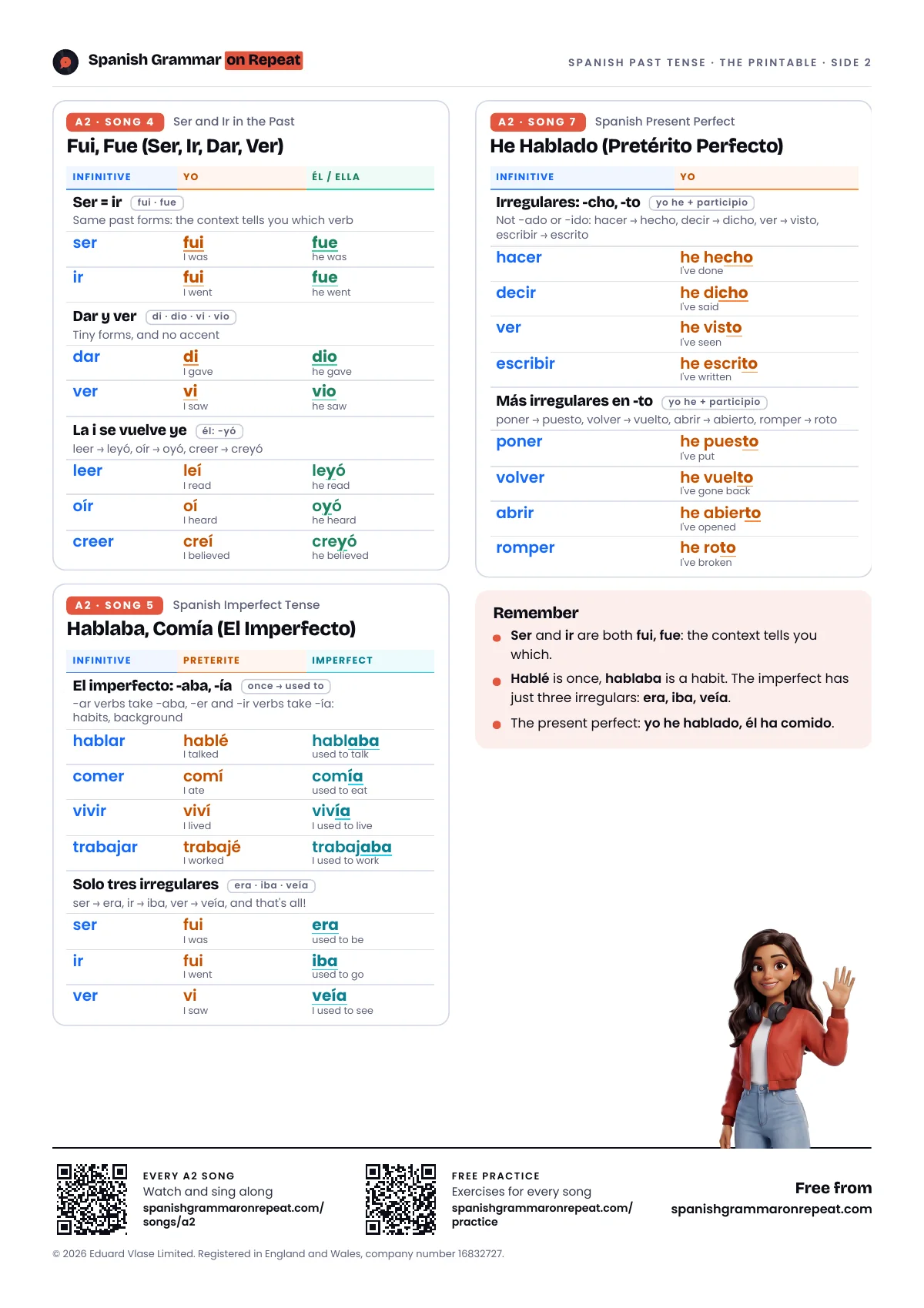
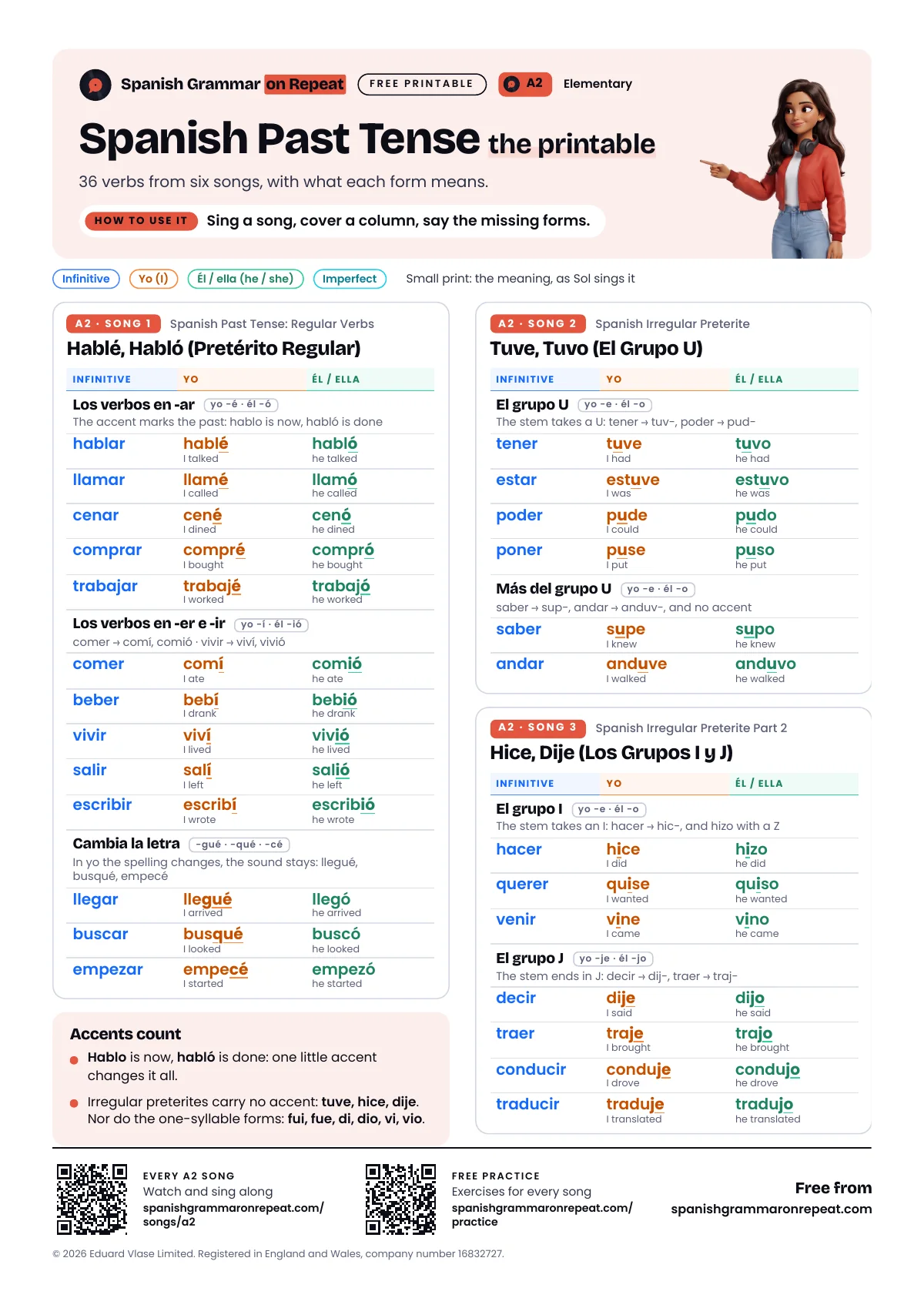
36 verbs from six past tense songs, yo and él / ella side by side with what each form means, in the same colours as the songs. Print it and test yourself one song at a time.
Just your email address: we send you a code, no password. Your quiz scores are saved too.
Take this song further
A printable workbook with an answer key, the five songs of El pasado as MP3s, and a certificate for when you've finished. The songs teach the regular preterite, the irregular preterites (tuve, hice, dije), ser, ir, dar and ver, and the imperfect.
Also: The Spanish past tense in songs, £6.99.
The verbs
The song sings the verbs in groups that follow one pattern, so you learn the pattern once and use it for every verb. The underlined part is what the group shares.
The accent marks the past: hablo is now, habló is done
| Infinitive | Yo | Él / ella |
|---|---|---|
| hablar | hablé | habló |
| llamar | llamé | llamó |
| cenar | cené | cenó |
| comprar | compré | compró |
| trabajar | trabajé | trabajó |
comer → comí, comió · vivir → viví, vivió
| Infinitive | Yo | Él / ella |
|---|---|---|
| comer | comí | comió |
| beber | bebí | bebió |
| vivir | viví | vivió |
| salir | salí | salió |
| escribir | escribí | escribió |
In yo the spelling changes, the sound stays: llegué, busqué, empecé
-gué · -qué · -cé| Infinitive | Yo | Él / ella |
|---|---|---|
| llegar | llegué | llegó |
| buscar | busqué | buscó |
| empezar | empecé | empezó |
Your turn
For example: «Ayer trabajé y cené con Ana.»
Answer in the YouTube comments